
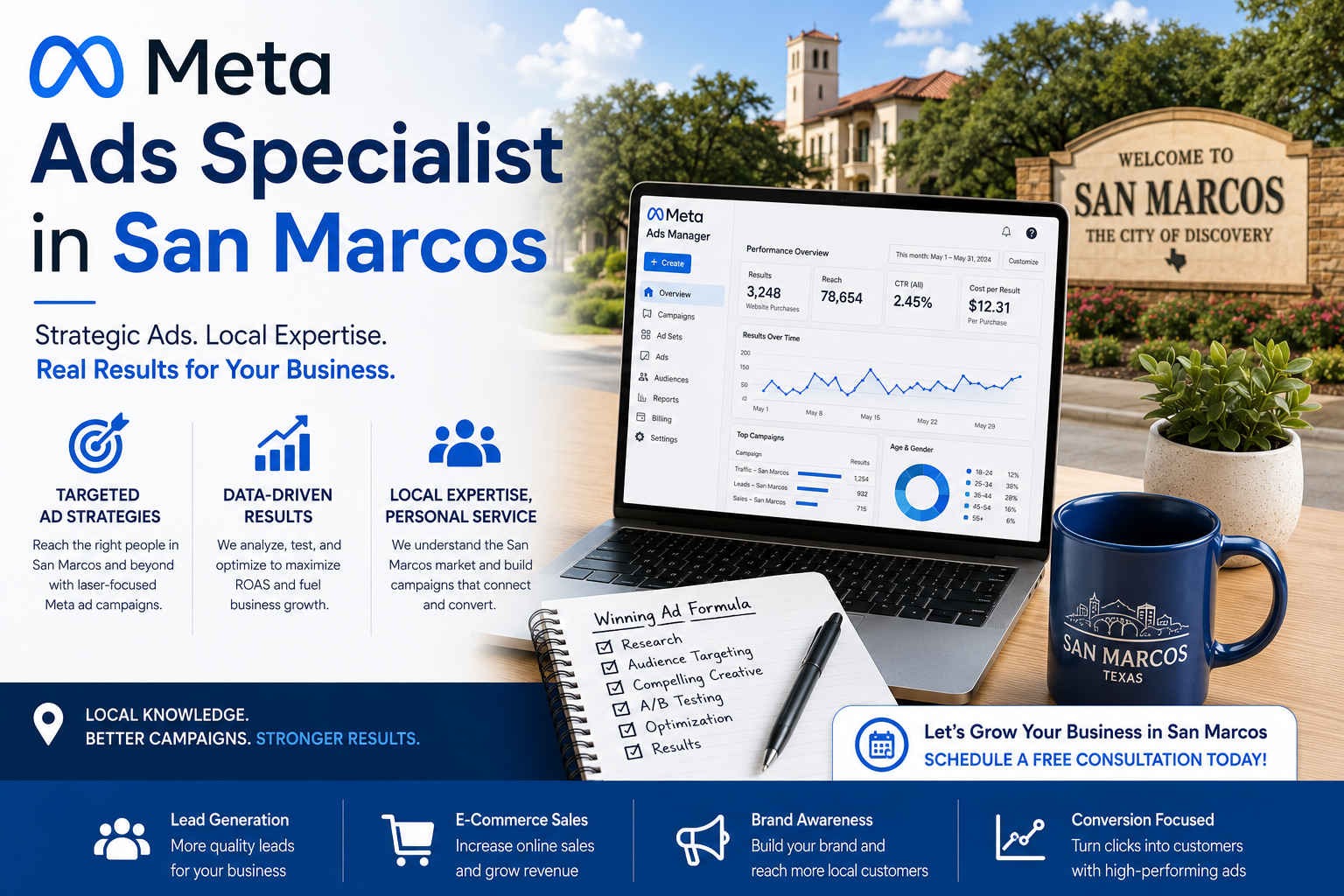
16 Jun Meta Ads Specialist in San Marcos
A Meta Ads specialist in San Marcos manages your Facebook and Instagram campaigns from strategy to daily optimization — audience targeting, ad creative testing, budget allocation, and conversion tracking — at a flat rate starting around $390 per month for local accounts. The right specialist turns your ad budget into a measurable stream of leads and bookings, without charging more when you scale.
Aruna Kulathunga is a Google and Meta-certified digital marketing specialist based in Escondido, California, with 7+ years of experience running paid social and search campaigns for travel, education, retail, and local service brands across three continents.
What does a Meta Ads specialist do that boosting posts doesn’t?
A Meta Ads specialist builds full-funnel campaigns in Meta Ads Manager with precise audiences, creative testing, and conversion tracking — the three things the “Boost Post” button never touches. Boosting sends money to Meta optimized for cheap engagement: reactions, shares, profile visits. A specialist optimizes for outcomes: phone calls, form submissions, bookings, purchases.
The work starts before any ad goes live. A specialist installs your Meta Pixel and Conversions API — the tracking layer that tells Meta’s delivery system which clicks are turning into actual customers. This matters more in 2026 than it did two years ago. Meta’s automation has taken over much of the audience-finding work, but it learns from conversion signals you feed it. Give it engagement signals and it finds you people who like your posts. Give it purchase and lead signals and it finds you people who buy.
From there, the job is audience strategy, creative testing, and ongoing management. For a San Marcos business, audience strategy means knowing how to target the residential growth around San Elijo Hills and Discovery Hills, the student population around Cal State San Marcos and Palomar College, the commuter traffic along Highway 78, and the established neighborhoods near Lake San Marcos — each behaves differently on social and responds to different offers.
Creative is where most local ad accounts win or lose. Ad creative — the image, video, or Reel your audience actually sees — drives more performance variance than any targeting setting. A specialist runs structured tests: two or three creative angles at a time, measured by cost per lead rather than clicks, with losing ads cut and winning formats scaled. That cycle, repeated monthly, is what separates a professionally managed account from a stagnant boosted-post rotation.
How much does Meta Ads management cost in San Marcos?
Professional Meta Ads management for a local San Marcos business runs $390 to $1,500 per month depending on the specialist, scope of work, and whether creative production is included. Most agencies charge either a flat monthly retainer or a percentage of your ad spend — typically 15–20% — with minimums that often push fees above $1,000 regardless of account size.
The percentage-of-spend model creates a structural problem for growing businesses: your management fees rise automatically as you scale your budget, even if the workload doesn’t change proportionally. A flat-rate structure removes that ceiling. You know exactly what management costs each month, independent of how much you’re spending on ads.
Three numbers to separate when comparing providers:
Management fee — what you pay the specialist. This should be explicit and fixed. Ad spend — what you pay Meta directly. This goes entirely to the platform and never passes through the specialist. Creative costs — photography, video production, graphic design. Some specialists include basic creative; others bill it separately or expect you to supply assets.
A transparent quote separates all three. A bundled “all-in $1,500/month” quote without line-item breakdown usually means a significant share of that number is management overhead, not ads.
Meta Ads vs Google Ads: which channel is right for my San Marcos business?
Meta Ads generates demand by showing your offer to local people who weren’t searching for it; Google Ads captures demand from people actively searching. The right channel depends on whether your customers already know they need what you sell.
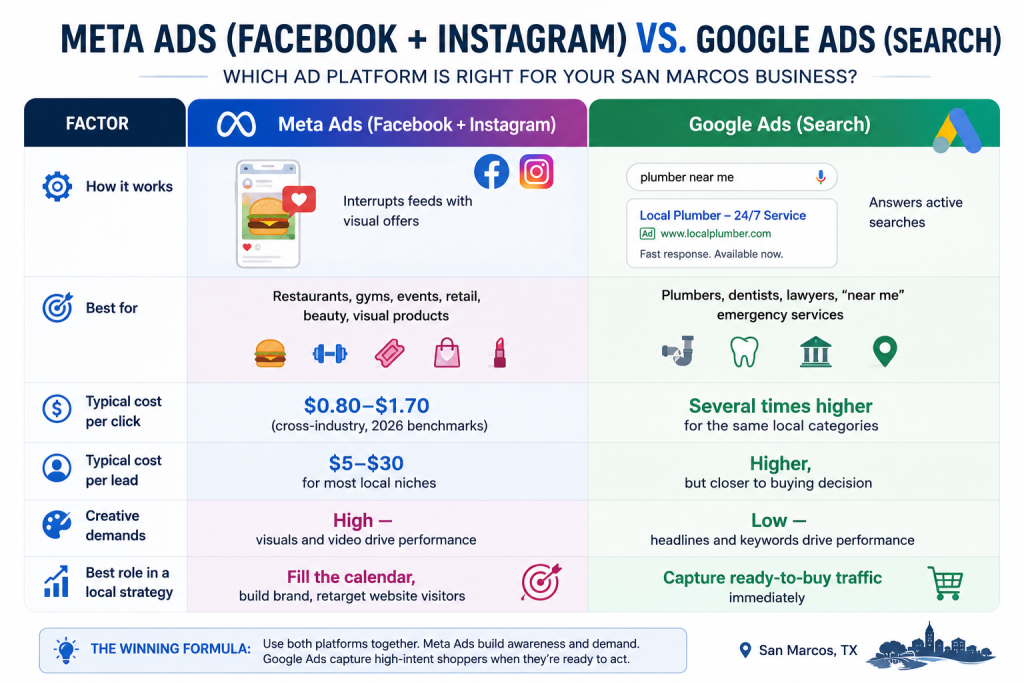
Industry benchmark data from WordStream shows Facebook’s average cost per click at $1.72 versus $5.26 on Google Search — Meta leads typically cost 30–50% less. That cost advantage is real, but so is the intent gap: a Meta lead saw your ad while scrolling and got curious; a Google lead typed your category into a search bar. Whether cheaper-but-colder leads deliver better ROI depends on your offer, your sales process, and how well your landing page or follow-up converts interest into appointments.
For most North County businesses, the practical answer is sequencing: start with one channel based on urgency, then layer the second as revenue allows. A new San Marcos restaurant with an opening offer runs Meta ads first, because they need to build local awareness fast. A plumbing company runs Google first, because their customers are searching at 7am with a burst pipe.
How much ad budget do I need for Facebook and Instagram ads?
Plan a minimum of $750–$1,500 per month in ad spend — the money that goes directly to Meta — separate from management fees. Campaigns under roughly $1,000 per month often struggle to exit Meta’s learning phase, which requires approximately 50 conversion events per ad set per week to stabilize.
The learning-phase issue is mechanical, not a sales argument for bigger budgets. Meta’s algorithm needs steady conversion volume to find your best audience efficiently. A $500/month budget generating a handful of leads per week keeps the algorithm in permanent learning mode, with volatile costs and inconsistent delivery. Crossing the threshold — even by a modest amount — is usually where cost per lead drops and consistency improves.
What you spend should also match your competitive landscape. The San Marcos–Escondido–Vista corridor spans a large and diverse market. Tight geo-targeting within a single zip code keeps your audience small and often raises CPMs; broadening to the surrounding North County area gives Meta’s system room to find buyers more efficiently, then you retarget the warm audience more narrowly. This is counterintuitive — less precise often costs less — and it’s one of the first things a good specialist adjusts.
How do I choose a Meta Ads specialist in San Marcos?
Choose a specialist who shows you cost-per-lead results, puts your ad account in your name, and has a clear creative testing process. Here is the vetting sequence I would use:
- Ask for results in business terms. Cost per lead, cost per customer, ROAS. If the portfolio leads with reach or impressions, that specialist is measuring activity, not outcomes.
- Confirm account ownership. Your Meta Business Manager, your ad account, your Pixel — all in your name. The specialist gets partner-level access. Anyone who insists on running your ads from their own account is retaining your data and your ad history when you leave.
- Ask about their creative process specifically. How many ad variants do they test? How often do they refresh creative? What signals tell them a creative is fatigued? Audience targeting has been largely automated by Meta’s Advantage+ system in 2026; creative quality is now the primary variable a specialist controls.
- Ask how they handle tracking. The right answer names both the Meta Pixel and the Conversions API. Browser-only tracking through the Pixel alone misses a significant share of conversions in iOS-constrained environments.
- Ask what month one looks like. A realistic answer describes learning-phase management and baseline data collection — not guaranteed leads in week one. Guaranteed lead volumes for a local paid social account are a red flag, not a selling point.
- Check the contract length and exit terms. Month-to-month arrangements or short initial terms signal confidence in results. Twelve-month lock-ins on a small local account are not standard practice and deserve scrutiny.
How long does it take for Meta Ads to produce results?
Expect your first leads within one to two weeks of launch, and stable, optimized performance by weeks eight to twelve. The gap between those two numbers is the learning phase, and understanding it prevents bad hiring decisions made at week three.
The pattern is consistent: month one surfaces which audiences and creative angles generate leads at all; month two cuts what isn’t working and scales what is; month three is where cost per lead settles at its real long-term level. The accounts I’ve managed that performed best at month six were the ones where the owner judged month one on process — tracking installed correctly, creative variants live, reporting clear — and month three on cost per lead.
Early signals that tell you a specialist is doing their job: Pixel and Conversions API firing correctly, multiple creative variants in rotation (not one ad running indefinitely), weekly or bi-weekly reporting tied to lead metrics, and clear communication about what is being tested and why.
Do Facebook and Instagram ads still work for local businesses in 2026?
Yes — Meta remains one of the strongest paid channels for local businesses reaching people who haven’t searched for them yet, with average costs per lead between $5 and $30 for most local service niches according to 2026 benchmark data from WordStream and industry agencies. What changed is how campaigns are won: audience targeting is increasingly automated, so creative quality and accurate tracking now determine results more than targeting precision does.
Meta’s Advantage+ tools handle much of the audience discovery that required manual work three years ago. That shift hasn’t made specialists redundant — it has moved the value of their expertise from tactical targeting tricks to strategic judgment about offers, creative angles, and what the data is actually saying. For a local business, this means the person you hire matters most for their understanding of your customers and market, not for any platform trick.
San Marcos specifically has favorable local dynamics for Meta advertising. A growing residential base in San Elijo Hills, Discovery Hills, and the North City development near CSUSM creates a steady flow of new residents who haven’t established local brand loyalties yet. The dining and retail corridor along San Marcos Boulevard has a dense concentration of businesses competing for the same local audience. The student and faculty population from Cal State San Marcos and Palomar College generates consistent demand across food, fitness, tutoring, and service categories. Businesses that show up consistently with compelling offers in this feed still buy attention far more cheaply than traditional local advertising — and they can measure every dollar of it.
A note on who I am and why I work from here
I moved to California from Sri Lanka last year, and I’m now based in Escondido — which means San Marcos is my local market too.
I spent the last seven years managing paid social and search campaigns for clients across South Asia, the UK, and Australia, including travel companies, e-commerce brands, universities, and service businesses. The fundamentals of what makes a Meta Ads account work — strong creative, clean tracking, offers matched to the right audience — don’t change across geographies. What changes is knowing the local context well enough to build campaigns that feel native to the market, not like ads copied from a template.
Working from North County San Diego means I’m in the same community as the businesses I serve. When I target San Elijo Hills families or student neighborhoods around CSUSM, I’m not reading about it — I’m here. That’s a different kind of accountability than remote agency work, and it’s one reason I prefer working with local businesses directly rather than through large agency structures.
My management fee starts at $390 per month, flat. No percentage of your ad spend. That rate does not increase because you decide to double your budget next quarter. It is a fixed cost for a defined scope of work, with month-to-month terms so you are never locked into something that isn’t performing.
If you’re a San Marcos business spending money on Facebook and Instagram ads that isn’t producing measurable leads, I’ll tell you why in an honest audit — no pitch attached. You can reach me through the contact form at arunkulathunga.com.
Aruna Kulathunga is a Meta and Google-certified digital marketing specialist based in Escondido, California. He works with small and mid-size businesses across San Marcos, Vista, Carlsbad, and the broader North County San Diego market.
FAQ
How much does a Meta Ads specialist cost in San Marcos? Meta Ads management in San Marcos typically runs $390 to $1,500 per month, separate from your ad spend. Flat-rate specialists charge a fixed monthly fee regardless of budget size; agencies often charge 15 to 20 percent of ad spend, which means fees rise automatically as your budget grows. (48 words)
Is boosting a Facebook post the same as running Meta ads? No. Boosting optimizes for cheap engagement such as reactions and shares. A campaign built in Meta Ads Manager optimizes for business outcomes including leads, calls, and bookings, with precise audience targeting, creative testing, and full conversion tracking. That difference is the core value a specialist provides. (46 words)
How much should I spend on Facebook and Instagram ads per month? Most local San Marcos businesses should plan at least $750 to $1,500 per month in ad spend paid directly to Meta. Budgets below roughly $1,000 per month often fail to generate enough conversion data for Meta’s algorithm to exit its learning phase and deliver consistent results. (46 words)
How long does it take for Meta Ads to generate leads? First leads typically appear within one to two weeks of launch. Stable, optimized performance with a predictable cost per lead takes eight to twelve weeks. Month one identifies what works; months two and three cut waste, scale what performs, and settle your true cost per lead. (46 words)
No Comments