
SEO Specialist in USA
SEO Specialist in USA: Costs, ROI, and How to Choose the Right One in 2026
An SEO specialist in the USA manages the technical, content, and link-building work that gets a business found in Google search results, typically charging $390 to $5,000 per month depending on the provider and scope. SEO remains one of the highest-return marketing channels available, with industry data showing organic search drives over half of all website traffic and an average return of $22 for every $1 spent.
Aruna Kulathunga is a Google-certified digital marketing specialist based in Escondido, California, with 7+ years of SEO, paid search, and content strategy experience across local service businesses, e-commerce, and international education brands in the US, UK, and Australia.
What does an SEO specialist actually do?
An SEO specialist improves how and where your business appears in search results by working across three connected areas: technical optimization, content, and authority building. Each area supports the others, and skipping one limits what the rest can achieve.
Technical SEO ensures Google can crawl, understand, and properly index your website. This covers site speed, mobile usability, structured data, and clean site architecture. Technical issues are often invisible to a business owner but directly cap your ranking potential. Site speed alone has measurable revenue impact: for every additional second of load time, conversion rates drop by an average of 4.42%, according to research from Portent, meaning a slow site is leaking revenue from the traffic it already has.
On-page and content SEO is the work of building pages that answer real search queries clearly and thoroughly. This includes keyword research, page structure, headings, and the actual content itself. Long-tail keywords, the longer, more specific search phrases, account for roughly 70% of all search queries, which means a content strategy built only around broad head terms is leaving most of the available search volume on the table.
Off-page SEO and authority building is how a specialist earns the external signals Google uses to judge trustworthiness, primarily backlinks from other relevant, credible websites. Quality and relevance of the linking source matter far more than volume. A handful of links from respected sites in your industry carries more weight than hundreds of low-quality directory submissions, and bulk link schemes carry real penalty risk in 2026’s algorithm.
A specialist’s actual day-to-day work cycles through auditing, fixing, publishing, building links, and measuring, repeated monthly, with priorities shifting based on what the data shows is holding your site back.
How much does SEO cost in the USA in 2026?
SEO costs in the USA range from $390 per month for a flat-rate independent specialist to $5,000 or more per month for a full-service agency, with the difference driven primarily by overhead rather than the underlying work itself.
Published 2026 industry data shows a wide and well-documented range. The average monthly SEO cost reported by Clutch is $3,199, while a 2026 Ahrefs survey of SEO professionals found freelancers average $71.59 per hour and agencies $98.90 per hour. Most published guides put the realistic range for small to mid-size businesses at $1,500 to $5,000 per month for agency-level service, with freelancers typically landing between $500 and $1,500 per month for similar scope.
A breakdown of what’s typically available at each price point in 2026:
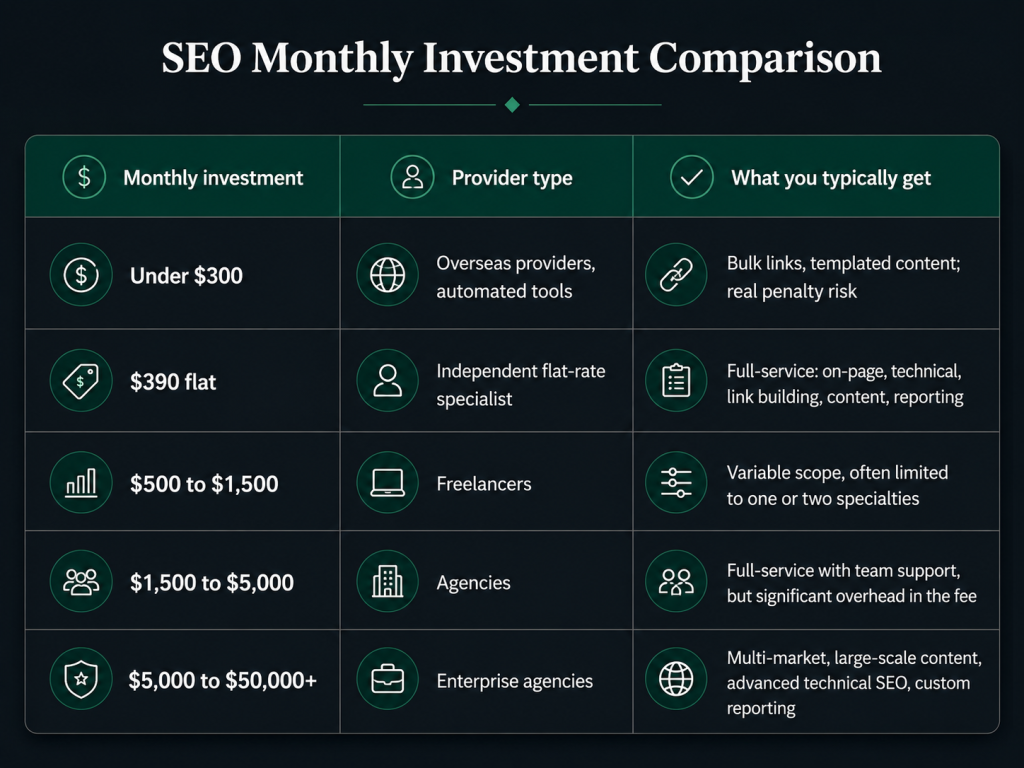
The factor that should drive your decision is not the headline number but what is actually included, and whether the provider can show you real results from comparable work. A bundled monthly fee with no breakdown between strategy, content production, and link building usually means a meaningful share goes to overhead that does not directly move your rankings.
What is the ROI of SEO compared to paid advertising?
SEO delivers a median ROI of 748% over three years according to First Page Sage’s analysis of client campaigns, with businesses earning an average of $22 for every $1 spent, compared to paid advertising’s per-click costs that stop producing the moment you stop paying.
The core economic difference between SEO and paid ads is durability. A page that ranks well today continues generating traffic and leads for months or years without additional spend, while a paid ad campaign produces zero results the day you turn off the budget. This is why SEO’s return compounds: First Page Sage’s data shows SEO reaching 2.6x ROI at the 12-month mark and exceeding 10x ROI at 24 months for top-performing campaigns, as ranked content keeps earning traffic indefinitely.
Lead quality also favors SEO. Organic search leads close at an average rate of 14.6%, compared to 1.7% for outbound marketing and roughly 3.75% for PPC traffic, based on data compiled across multiple 2026 industry reports. Cost per lead tells a similar story: organic search generates leads at roughly $31 per conversion, around 84% lower than the broader industry average of $198 across other channels.
None of this makes paid ads obsolete. Google Ads and Meta Ads produce leads immediately, which matters when a business needs revenue now. SEO is the channel that makes that revenue dependency shrink over time. The strongest strategy for most businesses uses paid channels to generate cash flow while SEO builds in the background, then leans more heavily on organic traffic as it matures.
How long does it take to see results from SEO?
Most SEO campaigns reach positive ROI within 6 to 12 months, with early ranking movement often visible in 60 to 90 days and the strongest returns typically arriving in year two and three. The timeline varies by industry competitiveness, starting domain authority, and consistency of execution, but the general pattern holds across most campaigns.
The first 60 to 90 days are foundation work: technical fixes, initial content, and the start of link building. Rankings during this period are volatile and traffic gains are modest. Between months four and six, lower-competition keywords typically begin ranking and organic traffic starts climbing visibly in Search Console data. Most campaigns reach a genuine break-even point between months six and twelve, after which the investment shifts from cost center to compounding asset.
Industry-specific data illustrates how much variation exists. First Page Sage’s 2026 analysis found eCommerce SEO breaking even in around 9 months with 317% three-year ROI, construction breaking even in 5 months with 681% ROI, and sectors like higher education and biotech seeing 788–994% three-year ROI with longer build times due to higher competition and content complexity. A specialist should be able to tell you, based on your industry and current competitive position, which end of that range your business is likely to land in.
Freelancer vs agency vs in-house SEO: which is right for my business?
For most small to mid-size businesses, an experienced freelance or independent specialist offers the strongest value, combining direct senior-level attention with significantly lower overhead than an agency or full in-house team. Agencies make sense at higher complexity and budget; in-house hiring rarely makes sense below a certain revenue threshold.
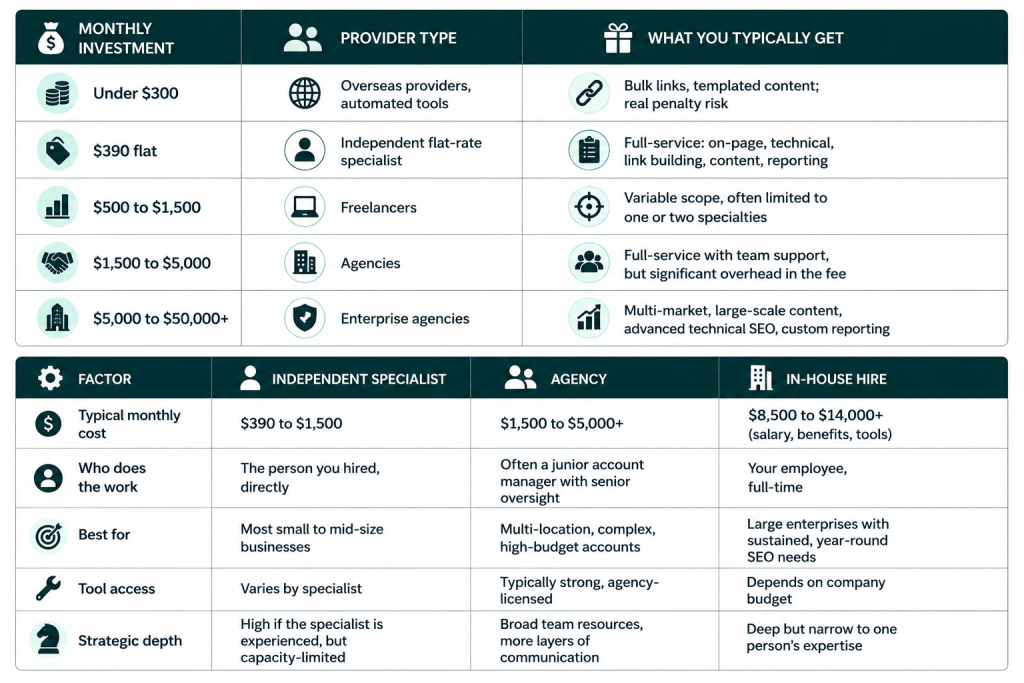
A single in-house SEO hire costs $102,000 to $168,000 per year once salary, benefits, and tools are included, which only makes financial sense once a business has enough scale and ongoing content needs to justify a full-time role. Most businesses under that threshold get better value from an independent specialist or agency.
What should be included in a legitimate SEO service?
A legitimate SEO service includes technical auditing and fixes, ongoing content production tied to real keyword research, white-hat link building from relevant sources, and transparent monthly reporting tied to traffic and leads, not just rankings. Anything missing one of these four pillars is incomplete, regardless of price.
Specific deliverables to expect on a monthly basis:
- A technical health check. Site speed, crawl errors, mobile usability, and structured data should be monitored continuously, not audited once at the start and ignored afterward.
- New or updated content targeting specific keyword opportunities identified through research, not generic blog posts published to hit a quota.
- Link building activity that you can verify: real outreach, real publications, real context. Ask to see where new links are coming from.
- Reporting that ties to business outcomes. Rankings and traffic are leading indicators; leads and revenue from organic search are what actually matter. A report showing only keyword positions, with no connection to traffic or conversions, is incomplete.
- Account ownership in your name. Your Google Search Console, Analytics, and any CMS access should belong to you, with the specialist working inside accounts you control.
The clearest red flag across the industry is a guarantee of specific rankings or a fixed timeline to “page one.” No legitimate provider controls Google’s algorithm closely enough to promise that, and any guarantee of this kind should end the conversation.
How is AI search changing SEO in 2026?
AI Overviews and AI-powered search now appear in roughly 60% of US search queries, which has reduced click-through rates on traditional organic results but has not reduced the importance of SEO, since AI systems pull their answers from the same well-optimized, authoritative content that ranks well organically. Businesses that maintain or increase SEO investment in 2026 are positioning for both traditional rankings and AI-generated answers.
The mechanics have shifted somewhat. Top organic click-through rates dropped from roughly 28% to 19% between 2024 and 2025 as zero-click searches, where the answer appears directly on the results page, have grown to an estimated 60% of all Google queries. This sounds like bad news for SEO, but the data suggests the opposite reaction from the market: 92% of marketers report they plan to maintain or increase their SEO spending in 2026, because the alternative, ceding visibility entirely, costs more than adapting strategy.
The practical shift for a specialist is content structure. Pages built with clear, direct answers near the top, strong topical depth, and well-organized supporting detail are the same pages AI Overviews tend to pull from, because both traditional ranking systems and AI summarization systems reward content that answers a query thoroughly and clearly. SEO in 2026 is less about chasing exact keyword matches and more about building genuinely comprehensive, well-structured resources that satisfy a search intent completely, whether the reader arrives through a blue link or an AI-generated summary.
A note on who I am and why I do this differently
I moved to the United States from Sri Lanka in 2025 and I am now based in Escondido, California, building my client base directly with US small businesses.
Before relocating, I spent seven years managing SEO, paid search, and content strategy for clients across South Asia, the UK, and Australia, including travel companies, universities, e-commerce brands, and local service businesses. That experience spans markets with very different competitive dynamics, which has shaped how I approach a new client: audit first, build a realistic timeline based on actual competition, and never promise outcomes I cannot control.
What I’m building here in the US is intentionally different from the agency model. My SEO management fee is $390 per month, flat. That covers technical SEO, content, white-hat link building, and monthly reporting, the same full scope most agencies charge $2,000 to $4,000 per month to deliver. There is no percentage of revenue, no bundled tool markups, and no long-term contract. I keep the fee low because I work directly with clients without the overhead of an account management layer between us, and I pass that savings on rather than charging what the market simply tolerates.
If your business has SEO that isn’t producing measurable traffic or leads, or you’re starting from nothing and want an honest assessment of what it will realistically take, I’ll look at your situation and tell you exactly where you stand. No sales pitch attached. Reach me directly at [email protected].
Aruna Kulathunga is a Google-certified digital marketing specialist and SEO strategist based in Escondido, California, serving small and mid-size businesses across the United States.
FAQ Page section
How much does an SEO specialist cost in the USA? SEO costs in the USA range from $390 per month for a flat-rate independent specialist to $1,500 to $5,000+ per month for a full-service agency. The difference is largely overhead: account managers, licensed tools, and office costs that independent specialists do not carry.
Is SEO worth the investment compared to paid ads? Yes, for most businesses building long-term visibility. SEO delivers a median 748% ROI over three years with businesses earning roughly $22 for every $1 spent, compared to paid ads that stop producing the moment spending stops. SEO compounds; paid advertising does not.
How long does SEO take to show results in 2026? Early ranking movement typically appears within 60 to 90 days. Most campaigns reach positive ROI within 6 to 12 months, with the strongest compounding returns arriving in year two and three as rankings, content, and authority continue building on themselves.
Do AI Overviews mean SEO doesn’t matter anymore? No. AI Overviews now appear in roughly 60% of US searches, but they pull answers from the same well-structured, authoritative content that ranks organically. 92% of marketers plan to maintain or increase SEO spending in 2026 because visibility in AI answers still depends on strong SEO fundamentals.