
Google Ads Specialist in USA
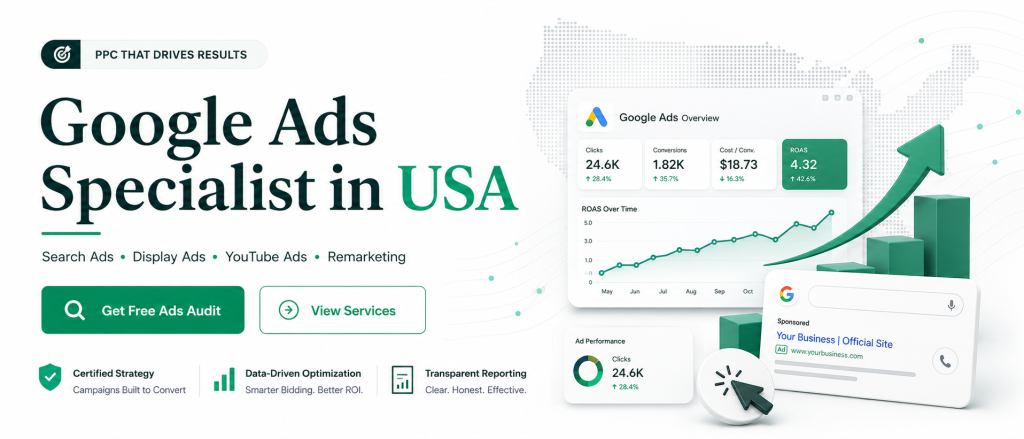
Google Ads Specialist in USA: Costs, ROI, and How to Hire the Right One
A Google Ads specialist in the USA manages campaign strategy, keyword targeting, bidding, ad copy, and conversion tracking, typically charging $390 to $5,000 per month depending on the provider and pricing model. Google reports an average return of $8 for every $1 spent on Search ads, but that figure depends entirely on having a specialist who manages the account well and tracks conversions accurately.
Aruna Kulathunga is a Google-certified digital marketing specialist based in Escondido, California, with 7+ years of experience managing Google Ads and Meta Ads campaigns for travel, education, retail, and local service brands across the US, UK, and Australia.
What does a Google Ads specialist actually do?
A Google Ads specialist builds and continuously manages the campaigns that put your business in front of people actively searching for what you sell, then removes wasted spend as the account collects data. The work breaks into a few connected responsibilities that repeat on a monthly cycle.
Keyword research and strategy come first, because the keywords you target determine who sees your ads and what each click costs. A specialist separates buying-intent searches from informational research searches, so budget goes to people closer to a purchase decision. Negative keyword management matters just as much: every irrelevant click blocked is budget redirected toward a real prospect.
Bid management and budget allocation happen continuously, not once at setup. As an account collects conversion data, a specialist shifts spend toward what is working and away from what is not, adjusts bids by device, time of day, and location, and monitors for waste before it accumulates.
Ad copy and landing page alignment is where many accounts underperform. The ad and the page it sends traffic to need to say the same thing and lead toward the same action. A specialist tests multiple ad variations and recommends landing page changes when the destination page is the actual bottleneck, not the ad itself.
Conversion tracking is the foundation everything else depends on. Without accurate tracking of calls, form fills, and purchases, a specialist is optimizing blind. Google’s reported average ROI of $8 for every $1 spent is only realistic when tracking captures the real picture of what is converting.
How much does Google Ads management cost in the USA in 2026?
Google Ads management in the USA typically costs $390 to $1,500 per month for an independent flat-rate specialist or smaller freelancer, $1,500 to $5,000 per month for a mid-market agency, and can exceed $10,000 per month for large or complex accounts. Published 2026 industry data shows freelancers generally charging $500 to $3,000 per month, while agencies commonly use either a flat retainer or a percentage-of-spend model in the 10% to 20% range.
A breakdown of what’s typically available at each tier:
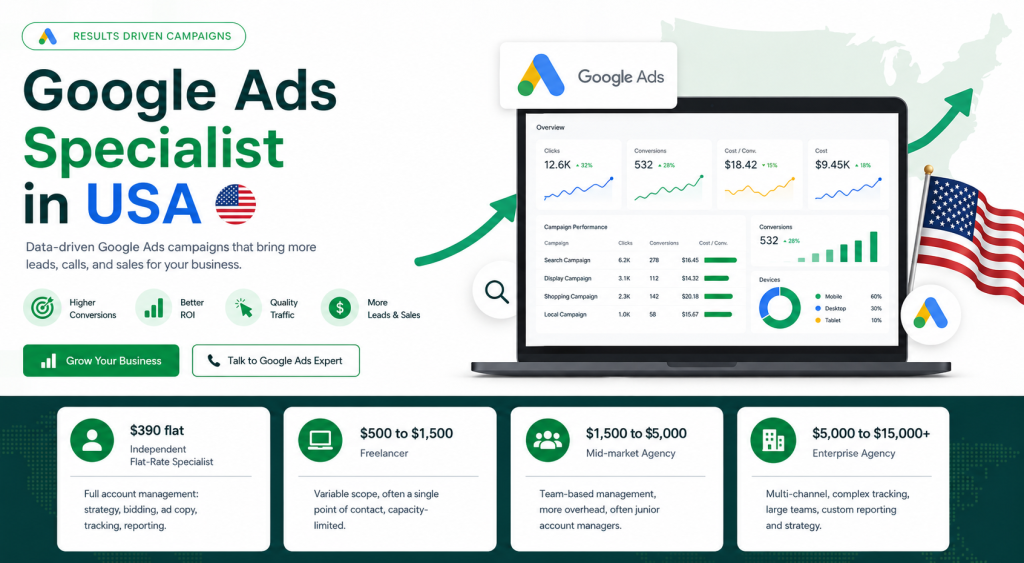
The pricing model matters as much as the headline number. A percentage-of-spend structure means your management fee rises automatically as your ad budget grows, even when the actual workload does not increase proportionally. If you spend $10,000 per month on ads at a 15% to 20% fee, you pay $1,500 to $2,000 in management costs; double your spend to $20,000 and your fee doubles too, regardless of whether the account got twice as complex. A flat-fee model avoids this entirely: the fee reflects the work, not an arbitrary share of your spend.
Hidden costs are common across the industry and worth asking about directly. Onboarding or setup fees, often $300 to $400 or more, frequently apply to new accounts, broken accounts being repaired, or major tracking overhauls. A transparent provider discloses these upfront rather than letting them appear on the first invoice.
What is the ROI of Google Ads, and how is it measured?
Google reports an average return of $8 for every $1 spent on Search advertising, but that average only holds when the account is managed competently and conversion tracking is accurate; a poorly managed account can waste a large share of its budget on irrelevant clicks before producing any return at all.
ROI in Google Ads is measured through cost per acquisition (what you pay to generate one lead or sale) and return on ad spend, the revenue generated divided by what was spent. Both metrics depend entirely on conversion tracking working correctly. An account without proper tracking might show acceptable click and impression numbers while having no real visibility into whether those clicks are turning into customers, which makes ROI claims meaningless regardless of how favorable they sound.
Industry cost-per-click data illustrates how much ROI potential varies by sector. Highly competitive categories like legal services and insurance see average costs per click above $65 to $70, because a single converted customer is worth thousands of dollars to those businesses, which justifies a higher acquisition cost. Lower-value categories see proportionally lower CPCs. This is why a single “average ROI” figure is less useful than understanding your specific industry’s cost structure and what a realistic cost per lead looks like before you start.
The bigger ROI lever for most businesses is not the platform but the management quality. A specialist who lowers your cost per lead by 20% through better targeting and tracking has the same financial effect as a 20% budget increase, without spending an extra dollar with Google.
Freelancer vs agency vs in-house: which is right for my business?
For most businesses spending under $10,000 per month on ads, an experienced independent specialist offers the strongest combination of senior-level attention and cost efficiency. Agencies make sense at higher complexity and spend; in-house hiring rarely makes financial sense below a significant scale threshold.
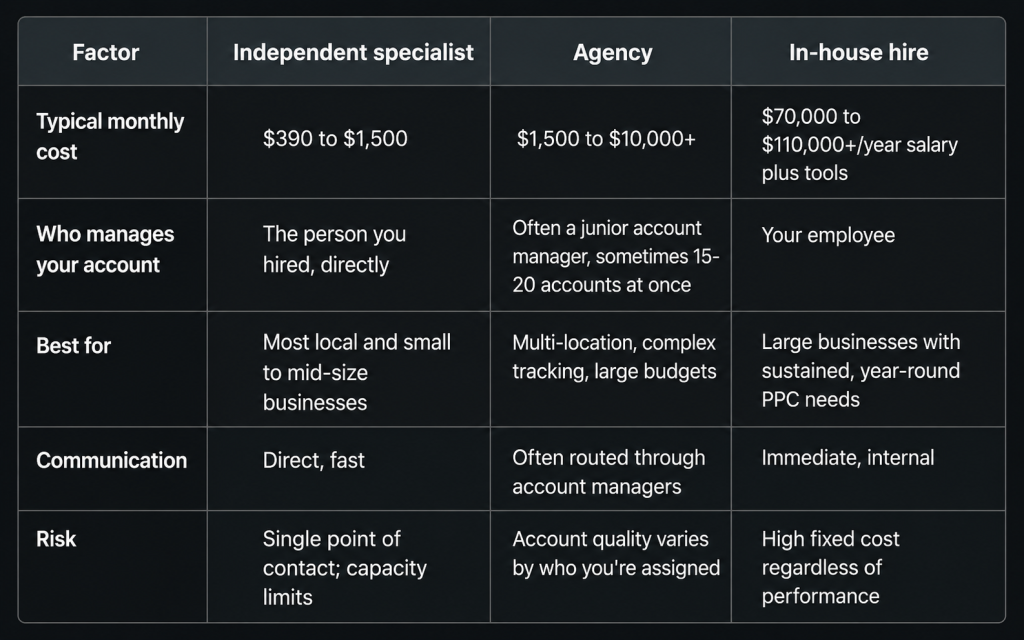
A common and reasonable question when comparing a freelancer to an agency is who actually does the work. Many agencies route new clients to a junior account manager handling a high volume of accounts simultaneously, with senior strategists only stepping in when something breaks. An independent specialist eliminates that layer entirely, you speak directly to the person managing your campaigns every time.
What pricing model is fair: flat fee vs percentage of spend?
A flat monthly fee is generally the fairer pricing model for most small to mid-size businesses, because it does not penalize you for growing your ad budget the way a percentage-of-spend structure does. Percentage-based pricing remains common in the industry, particularly at higher spend tiers, but it creates a structural misalignment as your budget scales.
The mechanics are straightforward. Under a 15% to 20% percentage model, your management fee is mathematically tied to your spend rather than to the complexity of the work. Scaling your budget from $5,000 to $15,000 per month does not triple the workload of running the account, but it does triple the fee. A flat-fee specialist charges based on the scope of work itself: strategy, ongoing optimization, and reporting, independent of how much you happen to be spending with Google that month.
There is a reasonable counter-argument for percentage pricing at very high spend levels, where genuinely more work is required to manage a larger, more complex account across multiple campaign types. But for most small businesses spending $1,000 to $10,000 per month, the workload does not scale linearly with budget, which makes flat-fee pricing the more honest match between cost and effort.
What red flags should I watch for when hiring a Google Ads specialist?
The clearest red flag is a guaranteed result, whether that is a guaranteed number of leads, a guaranteed cost per click, or a guaranteed return, since no legitimate provider controls Google’s auction closely enough to promise outcomes. A few other warning signs are worth checking before signing anything.
Ask directly who will be managing your account day to day, not who is doing the sales call. At larger agencies, the person pitching you is frequently not the person optimizing your campaigns. Ask how conversions are tracked and measured; a vague answer here predicts a vague account overall, since accurate tracking is the foundation of every other decision a specialist makes. Confirm that your Google Ads account, conversion tracking, and any connected analytics live under your ownership, not the provider’s, so you keep your full account history if you ever switch providers. Ask about contract length: month-to-month terms signal confidence in results, while long lock-in periods on a small account deserve scrutiny.
Watch for bundled pricing with no breakdown between management fee, ad spend, and any setup or tool costs. A transparent quote separates these clearly. A bundled number with no itemization usually means a meaningful share is overhead rather than ads actually reaching potential customers.
How long does it take to see results from Google Ads?
Expect your first clicks and leads within days of launch, but reliable, optimized performance typically takes 60 to 90 days as the account collects enough data to identify what is actually working. This gap between immediate activity and stable performance is the most common source of premature judgment about whether a specialist or the channel itself is working.
The first few weeks establish baseline data: which keywords convert, what a lead actually costs, and which ad variations perform best. The following month or two is where a specialist prunes underperforming keywords, scales what is converting, and refines targeting based on real account history rather than assumptions made at launch. Judging an account at week two on lead volume alone is judging it before the data exists to make good decisions; judging it at week two on setup quality, tracking accuracy, and communication is a fair and useful check.
A note on who I am and why I price this differently
I moved to the United States from Sri Lanka in 2025 and I am now based in Escondido, California, building my client base directly with US businesses.
Before relocating, I spent seven years managing Google Ads and Meta Ads campaigns for clients across South Asia, the UK, and Australia, including travel companies, universities, e-commerce brands, and local service businesses. That experience across different competitive markets has shaped a consistent approach: build accurate tracking first, set realistic expectations based on the actual competitive landscape, and never promise an outcome I cannot control on Google’s auction.
My Google Ads management fee is $390 per month, flat. No percentage of your ad spend, so your management fee never rises just because you decide to scale your budget. That covers strategy, ongoing bid and keyword optimization, ad copy testing, conversion tracking setup, and monthly reporting, the same scope most agencies charge $1,500 to $5,000 per month to deliver. I keep this rate low because I work directly with clients without an account management layer between us, and the savings from that structure pass directly to you rather than into agency overhead.
If you are running Google Ads right now and are not sure whether your spend is actually working, I will look at your account and tell you honestly what is going on, no pitch attached. Reach me directly at [email protected].
Aruna Kulathunga is a Google-certified digital marketing specialist based in Escondido, California, serving small and mid-size businesses across the United States.
FAQ Page section
How much does a Google Ads specialist cost in the USA? Google Ads management in the USA typically costs $390 to $1,500 per month for an independent specialist, and $1,500 to $5,000 or more per month for an agency. Pricing depends on whether the provider charges a flat fee or a percentage of your ad spend.
Is a flat fee or percentage of spend better for Google Ads management? A flat fee is generally fairer for small to mid-size businesses, since it does not increase just because you scale your ad budget. Percentage-of-spend models, common at 10% to 20%, tie your management cost directly to spend rather than to actual workload.
What is the ROI of Google Ads? Google reports an average return of $8 for every $1 spent on Search ads, but this depends on accurate conversion tracking and competent account management. Without proper tracking, ROI figures are unreliable, and poorly managed accounts can waste a significant share of budget on irrelevant clicks.
How long does it take to see results from Google Ads? First clicks and leads typically appear within days of launching a campaign. Reliable, optimized performance generally takes 60 to 90 days as the account collects enough data to identify which keywords and ads convert, then refine targeting and bidding accordingly.