
Meta Ads Specialist in USA
Meta Ads Specialist in USA: Costs, ROI, and How to Hire the Right One
A Meta Ads specialist in the USA manages your Facebook and Instagram campaigns end to end: audience strategy, creative testing, budget allocation, and conversion tracking, typically charging $390 to $5,000 per month depending on the provider and pricing model. Meta remains one of the most cost-efficient paid channels available, with average costs per click roughly a third of Google Search, but results depend heavily on creative quality and accurate tracking.
Aruna Kulathunga is a Google and Meta-certified digital marketing specialist based in Escondido, California, with 7+ years of experience running paid social and search campaigns for travel, education, retail, and local service brands across the US, UK, and Australia.
What does a Meta Ads specialist actually do?
A Meta Ads specialist builds full-funnel campaigns inside Meta Ads Manager with precise audiences, tested creative, and conversion tracking, the three things the “Boost Post” button does not touch. Boosting optimizes for cheap engagement like reactions and comments; a specialist optimizes for outcomes like leads, bookings, and purchases.
The work starts with tracking infrastructure. Before any ad runs, a specialist installs the Meta Pixel and Conversions API, the layer that tells Meta’s delivery system which clicks are actually turning into customers. This matters more in 2026 than it did a few years ago, because Meta’s automation now handles much of the targeting work that used to be done manually. The system still learns from the conversion signals it receives, so feeding it accurate data is what determines whether automation finds you good customers or just cheap clicks.
Audience strategy and creative testing follow. A specialist builds and refines audiences based on what the conversion data shows is working, then runs structured creative tests, typically two or three angles at a time, measured by cost per lead rather than engagement. Creative is the larger performance lever on Meta: ad quality directly affects auction costs, so the specialist who tests and refreshes creative consistently outperforms one who sets up an account and leaves it running unchanged.
Ongoing management covers budget allocation between prospecting and retargeting, creative refresh cycles before fatigue sets in, and monthly reporting tied to cost per lead and return on ad spend rather than vanity metrics like reach or impressions.
How much does Meta Ads management cost in the USA in 2026?
Meta Ads management in the USA typically costs $390 to $1,500 per month for an independent flat-rate specialist, and $1,500 to $5,000 per month or more for a full-service agency, with pricing structured as either a flat retainer or a percentage of ad spend, commonly in the 15% to 20% range.
A breakdown of what’s typically available at each tier:
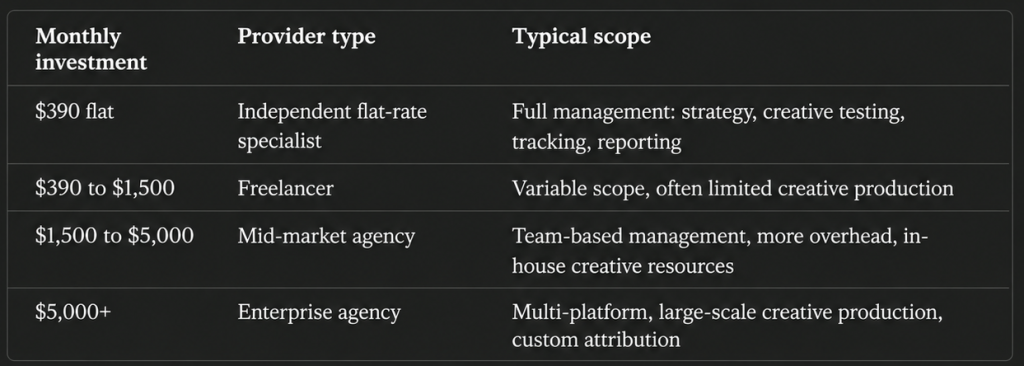
Two factors move price more than anything else: creative production and funnel complexity. If your specialist is also producing video, designing graphics, and writing landing pages, expect fees toward the higher end or separately itemized creative costs. A single-location business running straightforward awareness and offer campaigns is a lighter workload than an e-commerce brand running catalog ads, retargeting sequences, and weekly creative refreshes across multiple products.
As with Google Ads, the pricing model matters as much as the number. A percentage-of-spend structure ties your management fee directly to your ad budget rather than to the actual complexity of the work, which means your fee rises automatically as you scale, even if the workload does not grow proportionally. A flat fee avoids that entirely.
What is the ROI of Meta Ads, and how does it compare to Google Ads?
Meta Ads typically costs less per click and per lead than Google Search ads, with industry benchmark data showing Facebook’s average cost per click around $1.72 versus $5.26 on Google Search, making Meta leads roughly 30% to 50% cheaper on average. The tradeoff is intent: a Meta lead saw an ad while scrolling and got curious, while a Google lead actively searched for your category and is often closer to a buying decision.
Whether that cost advantage translates into better ROI depends on your offer and sales process. A lower cost per lead does not automatically mean a lower cost per customer if those leads convert at a lower rate once they reach a sales conversation. Businesses with strong creative, a compelling offer, and a fast follow-up process tend to make Meta’s cost advantage work in their favor. Businesses with weak landing pages or slow follow-up often see Meta leads underperform their cheaper acquisition cost.
ROI on Meta also depends more heavily on creative quality than Google Ads does, because Meta is an interruption-based channel: the ad has to earn attention rather than answer an existing search. This is why two businesses with identical budgets and audiences can see dramatically different results based purely on creative execution.
Freelancer vs agency: which is right for my business?
For most businesses spending under $10,000 per month on Meta Ads, an experienced independent specialist offers strong value: direct access to the person managing your account, lower overhead, and the flexibility to scale up creative support as needed. Agencies make more sense once creative production needs scale significantly or campaigns span multiple platforms and complex retargeting sequences.
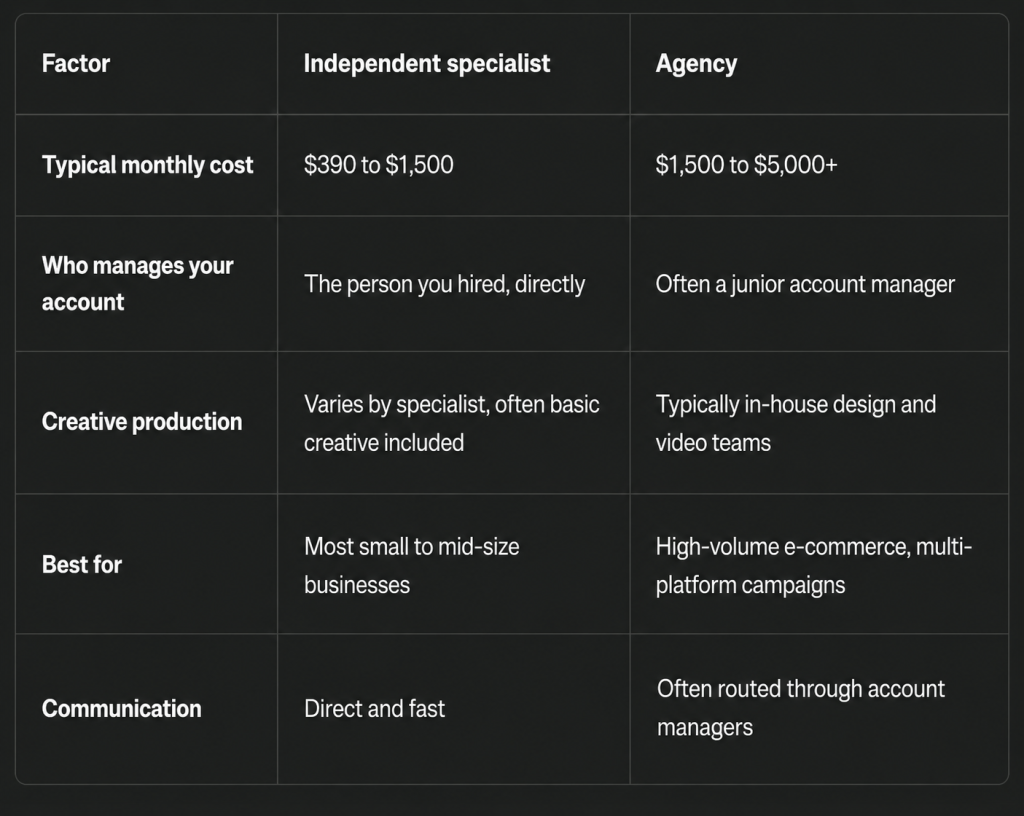
The question worth asking before hiring either is how much ongoing creative production your business actually needs. A service business running a handful of offer-based campaigns needs far less creative volume than an e-commerce brand running constant product promotions, and that difference should shape whether a specialist or a full agency creative team makes more financial sense.
What pricing model is fair: flat fee vs percentage of spend?
A flat monthly fee is generally the fairer model for most small to mid-size businesses on Meta, for the same structural reason it is fairer on Google Ads: a percentage-of-spend fee rises automatically as you scale your budget, even when the actual management workload does not increase at the same rate.
Under a typical 15% to 20% percentage model, doubling your ad budget doubles your management fee, regardless of whether the account became twice as complex to run. A flat-fee specialist prices based on the scope of work itself, strategy, creative testing, tracking, and reporting, independent of how much you happen to be spending with Meta that month. This also removes a subtle incentive problem: under percentage pricing, a provider benefits from you spending more, whether or not more spend is actually the right move for your business.
What red flags should I watch for when hiring a Meta Ads specialist?
The clearest red flag is a guaranteed lead volume or guaranteed cost per lead, since no legitimate specialist controls Meta’s auction or algorithm closely enough to promise a specific outcome. A few other checks are worth running before signing anything.
Confirm that your Meta Business Manager, ad account, Pixel, and Page all live in your name, with the specialist working inside your accounts on partner-level access. Anyone who insists on running your ads from their own Business Manager retains your data and ad history if you ever leave. Ask specifically about their creative testing process: how many variants they test, how often they refresh creative, and what signals tell them a creative has fatigued. Since targeting has become heavily automated through tools like Meta’s Advantage+, creative quality is now the primary variable a specialist actually controls, and a vague answer here predicts a stagnant account. Ask how they handle tracking, the right answer mentions both the Pixel and the Conversions API, since browser-only tracking alone misses a meaningful share of conversions in privacy-restricted environments. Check contract length: month-to-month terms signal confidence, while long lock-ins on a small account deserve scrutiny.
How long does it take to see results from Meta Ads?
Expect early leads within one to two weeks of launch, with stable, optimized performance typically arriving by weeks eight to twelve. The gap between those two points is Meta’s learning phase, the period during which the algorithm needs steady conversion data to find your best-performing audience efficiently.
The pattern is consistent across most accounts. The first month surfaces which audiences and creative angles generate leads at all. The second month cuts what is not working and scales what is. By the third month, cost per lead typically settles closer to its real long-term level. Judging an account at week two on lead volume is judging it before the algorithm has the data to perform well; judging it at week two on whether tracking is installed correctly, creative variants are live, and communication is clear is a fair and useful check at that stage.
A note on who I am and why I price this differently
I moved to the United States from Sri Lanka in 2025 and I am now based in Escondido, California, building my client base directly with US businesses.
Before relocating, I spent seven years managing Meta Ads and Google Ads campaigns for clients across South Asia, the UK, and Australia, including travel companies, universities, e-commerce brands, and local service businesses. Managing both paid search and paid social for the same clients over those years has shaped how I think about Meta specifically: it rewards strong creative and clean tracking more than any single targeting trick, and the businesses that treat creative as an ongoing process rather than a one-time setup are the ones that see consistent results.
My Meta Ads management fee is $390 per month, flat. No percentage of your ad spend, so the fee does not rise automatically as you scale your budget. That covers audience strategy, creative testing, conversion tracking setup, and monthly reporting, the same scope most agencies charge $1,500 to $5,000 per month to deliver. I keep this rate low because I work directly with clients without an account management layer between us, and that savings passes directly to you.
If you are running Facebook or Instagram ads right now and are not confident they are producing real leads, I will take a look at your account and tell you honestly what is happening, no pitch attached. Reach me directly at [email protected].
Aruna Kulathunga is a Meta and Google-certified digital marketing specialist based in Escondido, California, serving small and mid-size businesses across the United States.
FAQPage section (PAA-style)
How much does a Meta Ads specialist cost in the USA? Meta Ads management in the USA typically costs $390 to $1,500 per month for an independent specialist, and $1,500 to $5,000 or more per month for an agency. Pricing depends on whether the provider charges a flat fee or a percentage of ad spend, commonly 15% to 20%.
Are Facebook and Instagram ads cheaper than Google Ads? Usually, yes. Industry benchmark data shows Facebook’s average cost per click around $1.72 versus $5.26 on Google Search, making Meta leads typically 30% to 50% cheaper. However, Google leads come from active searches and often convert faster, so the better channel depends on the offer.
Is a flat fee or percentage of spend better for Meta Ads management? A flat fee is generally fairer for small to mid-size businesses, since it does not increase automatically as you scale your ad budget. Percentage-of-spend models tie your management cost directly to spend rather than to the actual workload involved in running the account.
How long does it take to see results from Meta Ads? First leads typically appear within one to two weeks of launch. Stable, optimized performance with a predictable cost per lead takes eight to twelve weeks, as Meta’s learning phase requires steady conversion data before the algorithm can deliver consistent results.