
Generative Engine Optimization Specialist in USA
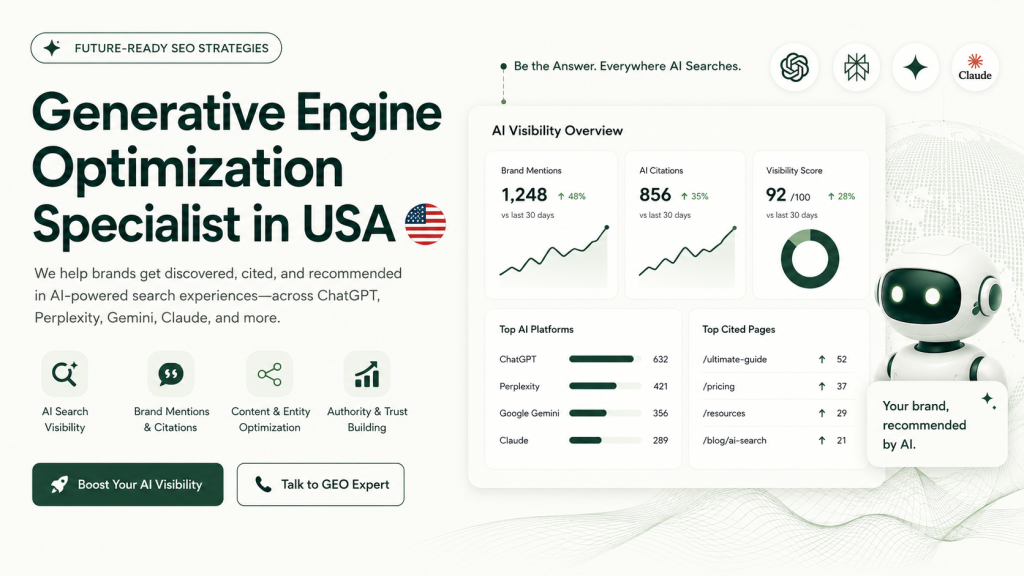
Generative Engine Optimization Specialist in USA: What GEO Is, Why It Matters, and What It Costs
A Generative Engine Optimization (GEO) specialist structures and publishes content so that AI systems like ChatGPT, Gemini, Perplexity, and Google AI Overviews cite your business when answering relevant questions, rather than just optimizing for ranking position on a traditional search results page. Full GEO management starts at $390 per month, and the case for it is no longer speculative: ChatGPT alone now reaches 900 million weekly active users, and research shows fewer than 10% of sources AI systems cite even appear in Google’s top 10 organic results for the same query.
Aruna Kulathunga is a Google-certified digital marketing specialist based in Escondido, California, with 7+ years of SEO, content strategy, and paid media experience, now applying that foundation to the emerging discipline of AI search visibility for clients across the United States.
Who is Generative Engine Optimization Specialist in USA (GEO) and how is it different from SEO?
GEO is the practice of structuring content so AI language models cite your business directly in their generated answers, while SEO is the practice of ranking your pages in the list of links a search engine returns. The two disciplines share technical foundations, but they optimize for different outcomes and are measured differently.
Traditional SEO success is a ranking position: you show up at position three for a keyword, and a user decides whether to click your link among several options. GEO success is a citation: an AI system reads your content, synthesizes it with other sources, and names your brand or pulls your statistic directly into its answer, often without the user ever seeing a list of competing links at all.
The overlap matters as much as the difference. Both disciplines reward clean site architecture, strong third-party backlinks, and well-structured, genuinely useful content. Where they diverge is in what gets prioritized beyond that foundation. SEO prioritizes keyword signals and ranking position. GEO prioritizes entity clarity (does the AI clearly understand what your business is and does), structured data, source diversity, and content freshness, since research shows recently updated content appears roughly four times more often in AI answers than stale content of similar quality.
The gap between the two is documented and significant. Research cited across multiple 2026 industry analyses found that the overlap between top-ranking Google pages and the sources AI systems actually cite has dropped from roughly 70% to below 20%. Ahrefs separately found that 28.3% of ChatGPT’s most-cited pages have zero organic visibility in Google at all. Ranking well on Google no longer predicts whether AI systems will cite you, which is the entire reason GEO exists as a distinct discipline rather than just being absorbed into SEO.
Do I actually need GEO if I already rank well on Google?
Likely yes, because strong Google rankings help your odds of AI citation but do not guarantee it, and a meaningful share of AI-cited content comes from pages that rank poorly or not at all in traditional search. Ranking position one in Google gives a page roughly a 58% chance of being cited in AI Overviews; by position ten, that drops to 14%, according to 2026 research from Growth Memo. Strong rankings help, but they are far from a guarantee, and the businesses most exposed are the ones assuming their SEO investment automatically covers AI visibility.
The scale of what’s at stake is growing quickly. Google’s AI Overviews now appear in an estimated 25% to 40% of all search queries depending on query type, and roughly 58.5% of US searches already end without a click, a figure that rises to approximately 83% when an AI Overview is present. That means a meaningful and growing share of people researching your category never see a traditional list of links at all, they see a synthesized answer, and either your business is named in it or it isn’t.
The financial argument is just as direct. Multiple independent analyses in 2026, including data from Ahrefs and various GEO research firms, found AI-referred visitors converting at dramatically higher rates than typical organic search traffic, in some documented cases by a factor of several times over, because users arrive at your site already having received something like an endorsement from the AI system itself, rather than just a blue link among ten options. A business invisible in AI answers is not just missing some traffic; it is missing some of the highest-intent traffic available today.
How much does it cost to hire a GEO specialist?
I am Generative Engine Optimization Specialist in USA and my management starts at $390 per month for an independent specialist handling content structuring, citation tracking, and entity optimization, with broader engagements at agencies running higher depending on scope and the number of AI platforms monitored. Because GEO is still a young discipline, published market pricing is less standardized than it is for SEO or paid ads, but the scope of work and the skills required overlap closely enough with SEO that similar pricing logic applies.
What a $390 per month GEO engagement typically includes:
Content restructuring for AI extractability. Rewriting and reorganizing existing pages so that direct, complete answers appear early, in short paragraphs, since AI systems are looking for extractable answers rather than content that builds slowly toward a conclusion.
Entity and structured data optimization. Ensuring your business, products, and key facts are clearly defined through schema markup and consistent information across your site, since AI systems need to understand what your business is before they can cite it accurately.
Citation monitoring. Tracking whether and how often your brand appears across relevant AI-generated answers on platforms like ChatGPT, Perplexity, and Google AI Overviews, since this is the actual success metric for GEO work, not keyword rank.
Third-party authority building. Earning mentions and citations on platforms AI systems already trust heavily, since data from 2026 shows AI systems lean toward sources like Wikipedia, Reddit, and established publishers; a brand’s own website is rarely enough on its own.
Monthly reporting on citation share, not just traffic, since the entire point of GEO is visibility inside AI answers rather than clicks to your site.
What does a Generative Engine Optimization Specialist in USA actually do, day to day?
A GEO specialist audits existing content for AI-readability, restructures it to lead with direct answers, builds the structured data and entity signals AI systems rely on, and continuously monitors where your brand is and is not appearing in AI-generated responses. The discipline is less about producing brand-new content constantly and more about restructuring and strengthening what already exists, then tracking the results in a fundamentally different way than traditional SEO reporting.
Content audits come first. A specialist reviews your existing pages against what 2026 research shows actually drives AI citations: content with structured lists, direct quotes, and verifiable statistics shows measurably higher visibility in AI responses, with one large study finding a 30% to 40% lift in AI visibility for content built this way compared to unoptimized pages. Most existing business websites were written for human scanning and SEO keyword targeting, not for this kind of extraction, which means restructuring is usually the first and highest-leverage move.
Citation monitoring is the ongoing core of the work. Unlike a Google ranking, which stays relatively stable once achieved, AI citations are documented to be more volatile. Some industry research tracking high-traffic prompts found certain citations churning at a rate of roughly 23% month over month, and when a brand loses a citation, the median time to recover it runs around 45 days, with a competitor displacing that citation being the cause in a large majority of cases. A specialist who only checks in occasionally will miss this churn; this is closer to ongoing brand monitoring than a one-time optimization project.
Third-party presence building rounds out the work, since GEO visibility depends heavily on sources outside your own website. AI systems frequently cite platforms like Wikipedia, Reddit, and established review or publisher sites alongside or instead of brand-owned content, which means a GEO specialist’s work extends beyond your website to where your business is discussed elsewhere online.
How is GEO success measured if not by rankings?
GEO success is measured by citation share, how often your brand appears across a defined set of relevant AI prompts, rather than by keyword ranking position. The practical metric is sometimes called Share of Model: out of a representative set of prompts someone in your category would realistically ask an AI system, what percentage actually surface your brand.
This is a meaningfully different measurement framework than SEO reporting, and it requires deliberate testing rather than passive tracking. One documented example from 2026 GEO research involved a travel brand tracking 180 AI-generated responses across six topic clusters; the brand appeared in just 13 of them, a Share of Model of 7.2%, while a handful of larger competitors dominated the same prompt set. That number, not a list of keyword rankings, is what a GEO engagement is trying to move.
Secondary metrics matter too: direct AI referral traffic (still small in absolute terms for most businesses but growing quickly and converting unusually well), brand mention frequency even without an explicit link, and sentiment, whether AI systems describe your brand favorably when they do mention it. A complete GEO report should include some version of all three, not just one.
How long does it take to start appearing in AI-generated answers?
Meaningful improvement in AI citation share typically takes a similar timeline to early-stage SEO, around two to four months for initial movement, though some specific quick wins, like correcting a structured data gap or restructuring a single high-relevance page, can show up faster because individual AI citation events are not gated by the same domain-authority accumulation that traditional ranking requires.
The reason timelines vary more than they do in SEO is that AI citation behavior is documented to be less stable. A business can gain a citation relatively quickly after a content fix, since AI systems frequently retrieve and re-evaluate content rather than relying purely on accumulated long-term authority signals. But that same instability means a citation gained can also be lost, sometimes within weeks, if a competitor publishes more current, more clearly structured content addressing the same query. This is part of why GEO is best understood as ongoing brand visibility management rather than a project with a defined finish line.
Is GEO replacing SEO, or do I need both?
You need both. GEO does not replace SEO; it builds on the same technical and content foundations while adding specific requirements that SEO alone does not address, and most credible industry analysis in 2026 is explicit that treating GEO as a substitute for SEO, rather than an addition to it, is a strategic mistake.
The reason both remain necessary is structural. Google’s AI Mode, for example, still draws its answers exclusively from Google’s own search index, meaning a page that does not rank in Google traditionally will not be cited there either, regardless of how well it’s structured for AI extraction. At the same time, platforms like ChatGPT and Perplexity pull from a broader web index and have shown a documented and growing tendency to cite sources that rank nowhere near the top of Google for the same query. A business optimizing only for one discipline is leaving meaningful visibility on the table in the other.
The practical sequence for most businesses: maintain strong SEO fundamentals, since they remain the floor GEO is built on, then layer in the specific structural and citation-monitoring work GEO requires. Businesses that already have decent organic visibility but feel invisible in AI tools are usually missing the content restructuring and entity clarity work, not starting from zero.
A note on who I am and why I’m building this differently
I moved to the United States from Sri Lanka in 2025 and I am now based in Escondido, California, building my client base directly with US businesses.
I spent seven years working in SEO, paid search, and content strategy before AI search existed as a serious channel, which means I came to GEO from the SEO side rather than as a separate, newly invented specialty disconnected from search fundamentals. That matters because the strongest GEO work in 2026 is still built on the same things that made content rank well in 2020: clarity, structure, genuine usefulness, and accurate information, with a specific new layer of monitoring and restructuring on top.
My GEO management fee is $390 per month, flat, the same rate I charge for SEO management, because the underlying skill set and content work overlap significantly. That covers content audits and restructuring, entity and structured data optimization, citation monitoring across major AI platforms, and monthly reporting on citation share rather than just traffic. No long-term contract, no separate fee for tools.
If you are not sure whether your business shows up when people ask ChatGPT, Gemini, or Perplexity about your category, I will run a citation check and tell you honestly where you stand. No pitch attached. Reach me directly at [email protected].
Aruna Kulathunga is a Google-certified digital marketing specialist based in Escondido, California, serving small and mid-size businesses across the United States with SEO, GEO, and paid media services.